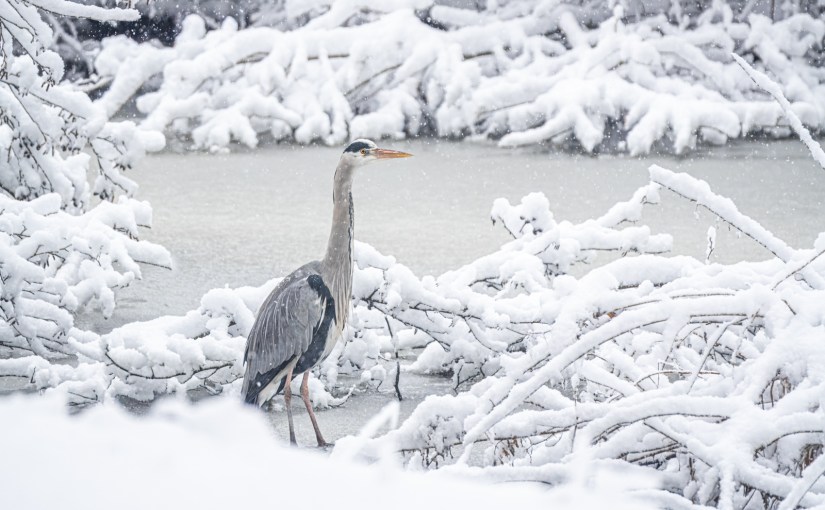
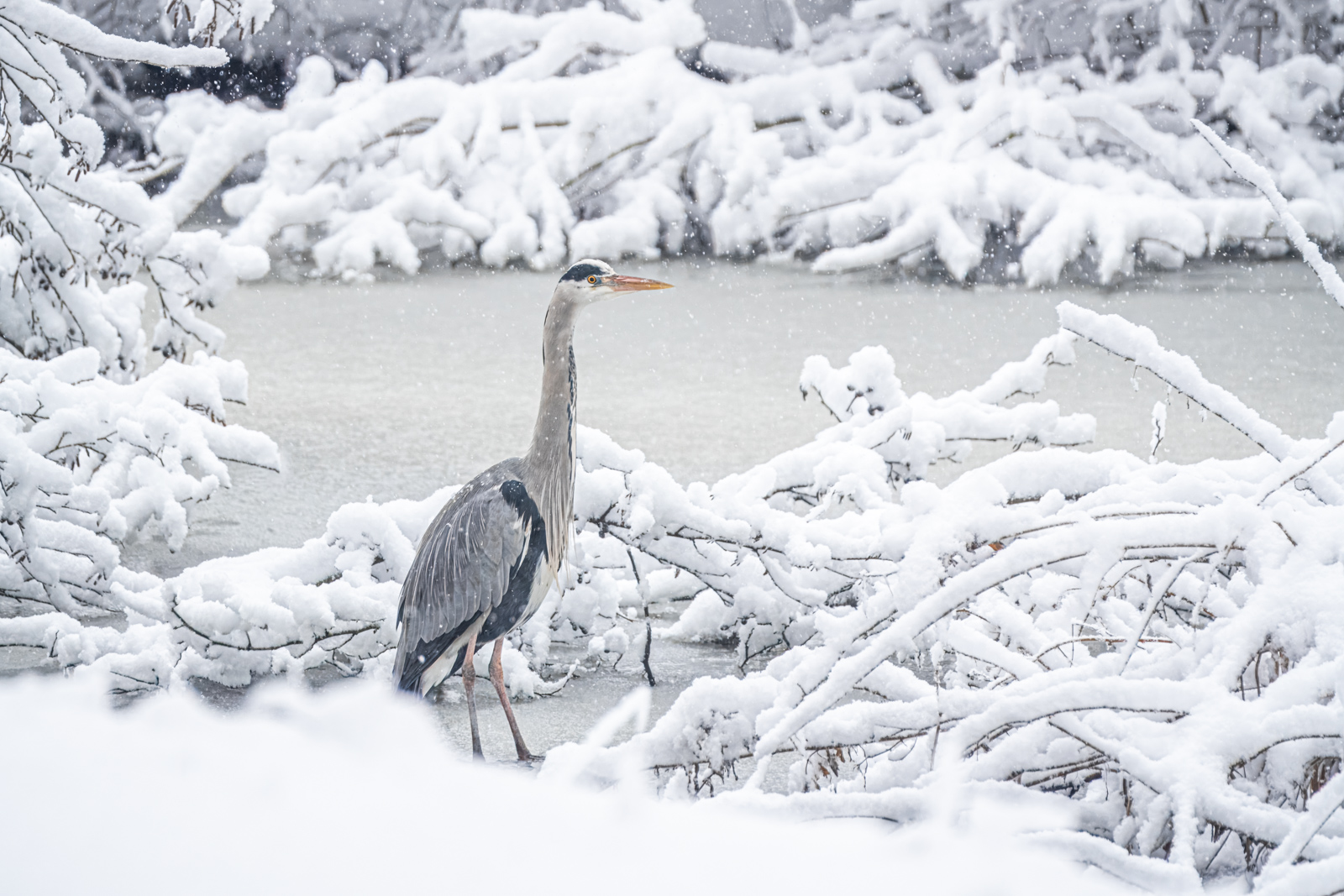
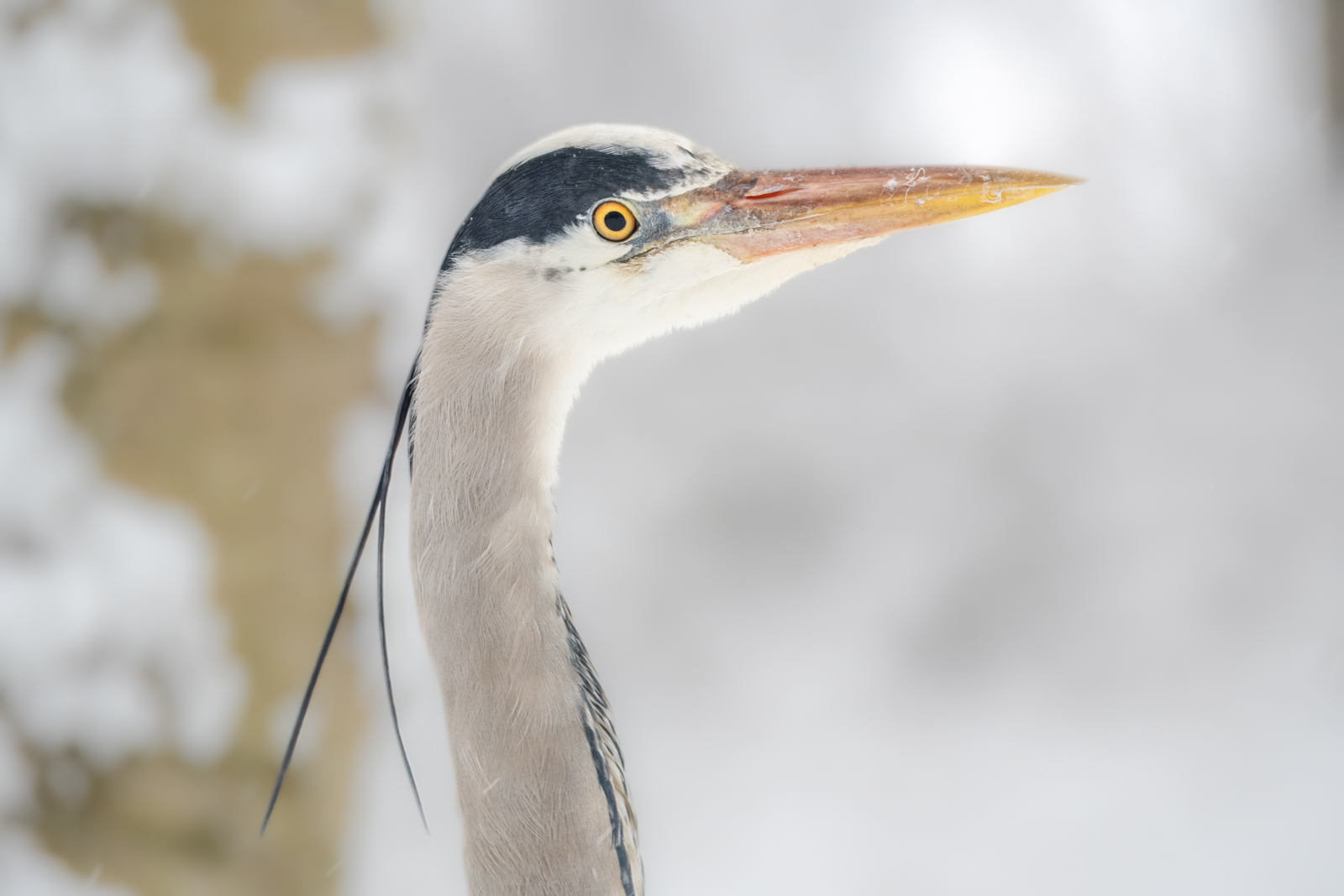
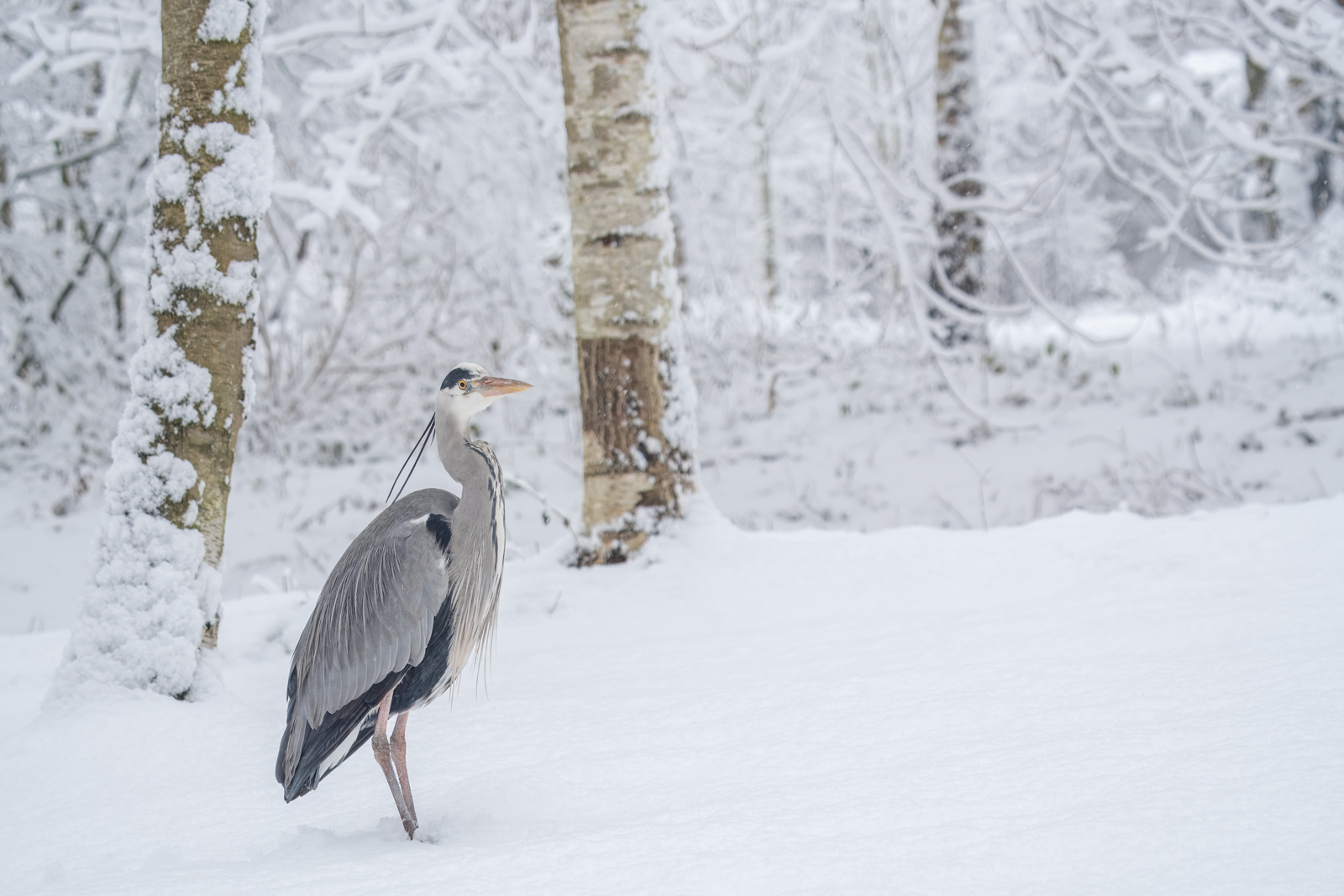
I’m sure I wasn’t the only photographer out there with my camera this Monday, right after the first snowfall of the year… We haven’t had such a thick layer of snow in years, and it resulted in fantastic images! In my local area: Bijlmerweide in Amsterdam Zuidoost, I was able to photograph this grey heron—first from a distance, in the landscape near the water, in the falling snow. Later, he gradually came closer.
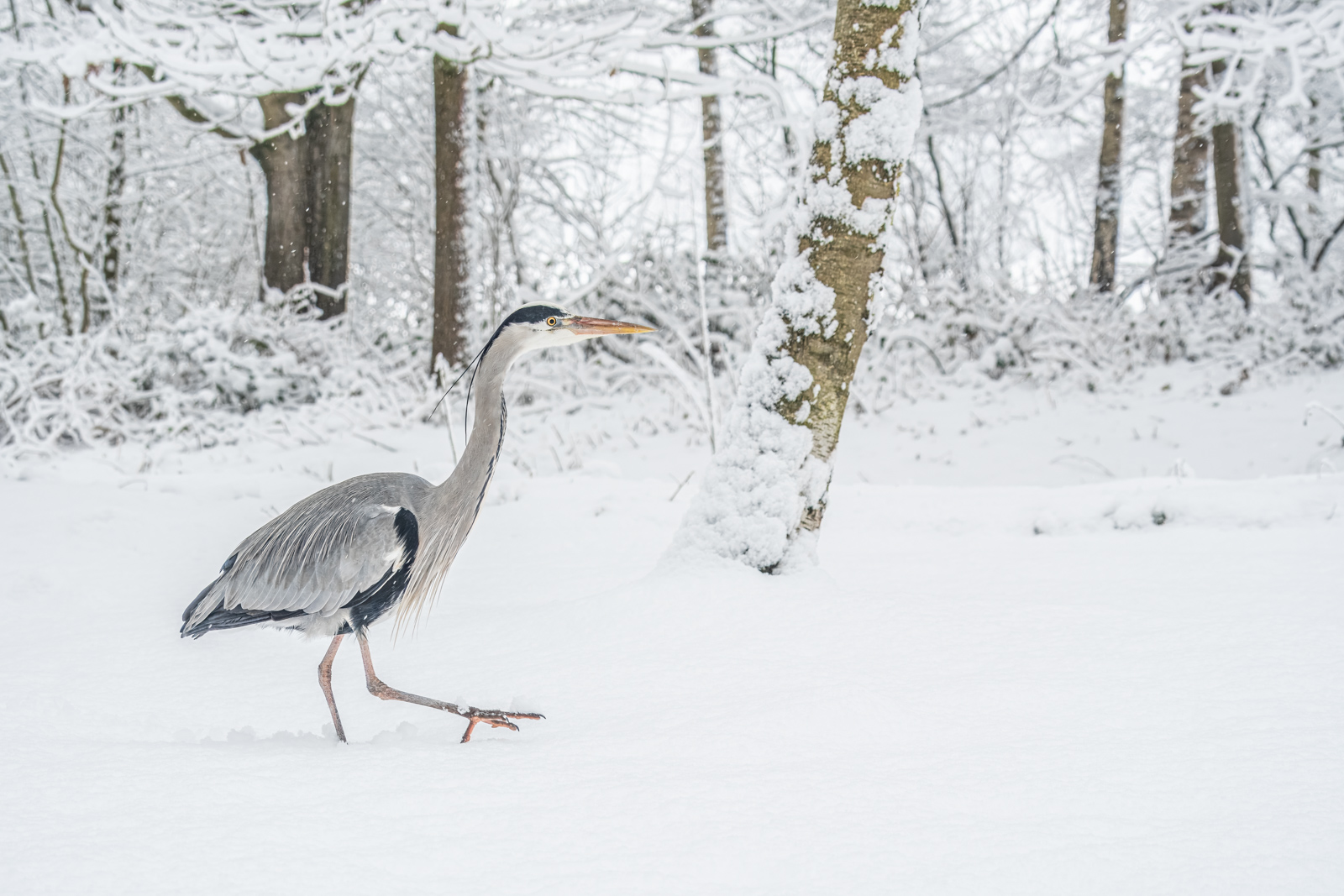
After watching me from a distance for a while, and then, to my surprise, walking straight towards me, it finally swerved and circled me with a stately, purposeful stride.
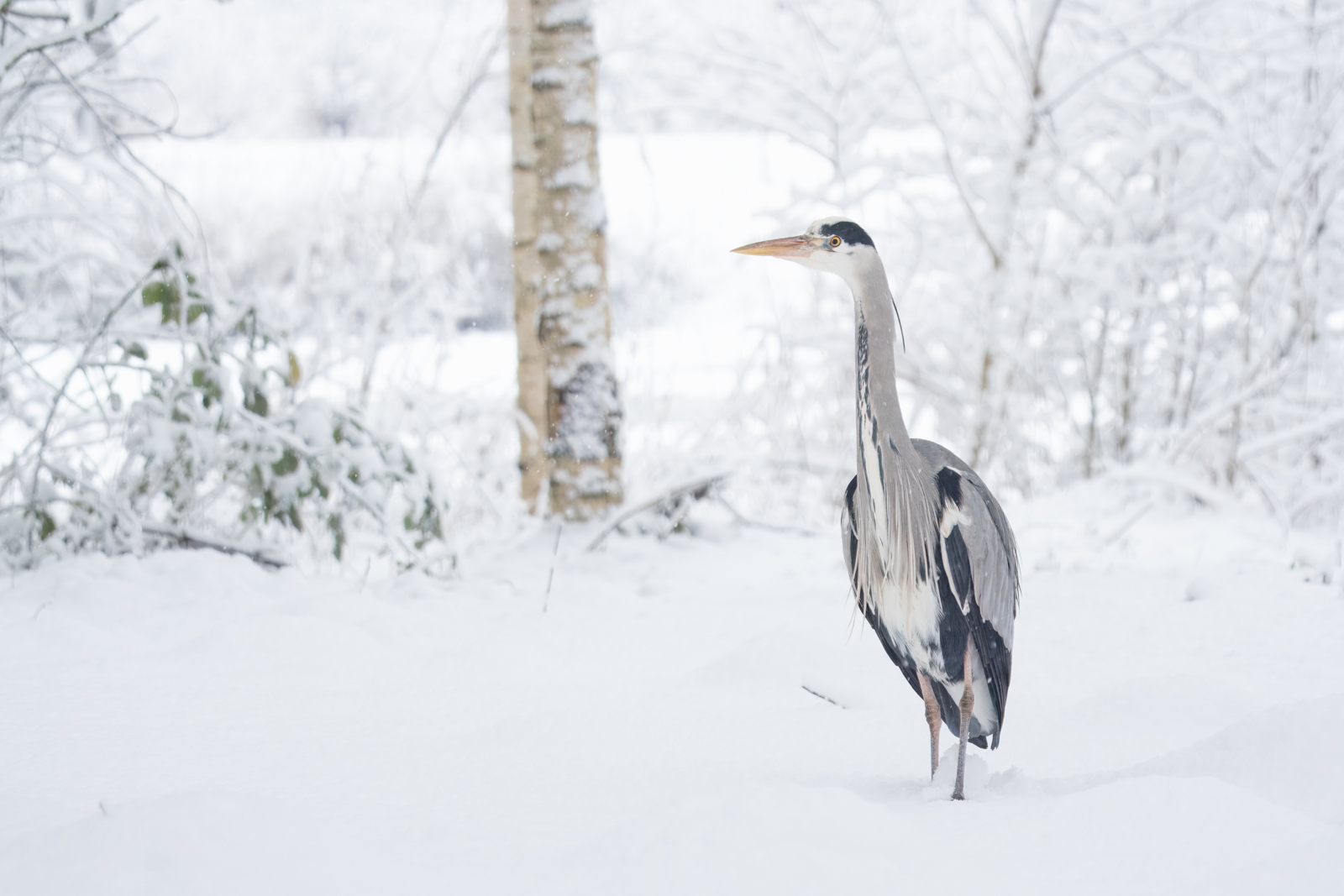
There it stood still again, watching me intently… so close now, and so relaxed, that I could easily get a close-up with the telephoto zoom…
A special experience: being stalked by a heron. Only much later did I realize that, because of the plastic bag around my camera, he probably thought he was going to be fed… So, begging heron! 😀 Too bad for him: I didn’t have any food with me either. But I did get a nice series of photos!
And the heron? … once he was truly convinced I had nothing to offer him, he took to the wing and slowly winged away, looking for a snack a little further away!
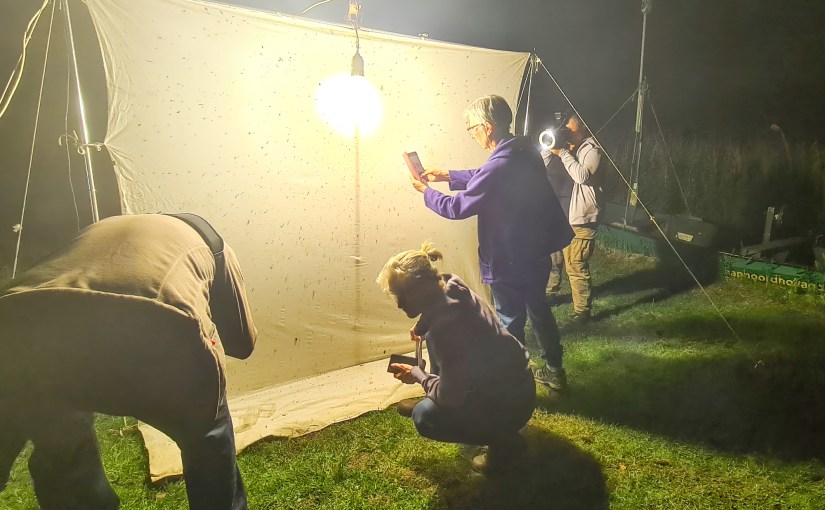
Two weeks ago we were able to participate for the first time in a Moth count led by Nico Dekker, Coordinator Butterfly Working Group (Vlinderwerkgroep) KNNV – Ilperveld, Landsmeer at Visitors Centre Landscape North Holland. What a special experience! Behind the visitors centre of the Ilperveld a white cloth measuring several metres was stretched, which was illuminated by a very strong, vibrating lamp. It was switched on as soon as it started to get dark, around 22:30, and immediately the first insects appeared: moths, but also beetles, flies, mosquitoes, and a lot of other small fry… Within no time there were hundreds of them. Quite a ticklish feeling!
Inventory and identification
A few people from the Butterfly Foundation and some other interested parties had quickly positioned themselves around the cloth, and took turns in an attempt to photograph and/or identify as many of these creepy crawlies as possible.
Hopwortelboorder – Hepialus humuli
Nico had an insect book with him to identify the various species, and here and there we were shown some beautiful species and given names. Apart from that I was mainly dependent on taking photos – in the hope that they would be good enough to have them identified later via Observation.org.
Photographing insects in the dark
Taking photos in the dark turned out to be even more complicated than expected. Everything moved, flew, hopped, crawled and hopped around, in such large numbers that you didn’t know where to look first, let alone how and where to focus. In addition, the flickering lamp appeared to project red horizontal lines on the canvas, which were not visible to the naked eye, but were visible in the photos. All photos were therefore significantly lightened in post-processing, sharpened and noise-free, and where possible the background was cleaned up a bit.
After sorting through hundreds of photos, and with a bit of luck and a lot of fiddling, you are moving from this :
It is unbelievable how many different species we saw that night! I was able to identify and name a total of 71 different species using Waarneming.nl. But there were many more. Beautiful creatures with often equally surprising and poetic names. The ‘top pieces’ of the evening for me were undoubtedly the Ermine Moth and the Rhinoceros Beetle. But certainly also some other gems that you can see below in my personal ‘top 10’. You can soon find a number of others on my website Photodeck Steppeland – Moth Count(work in progress…)
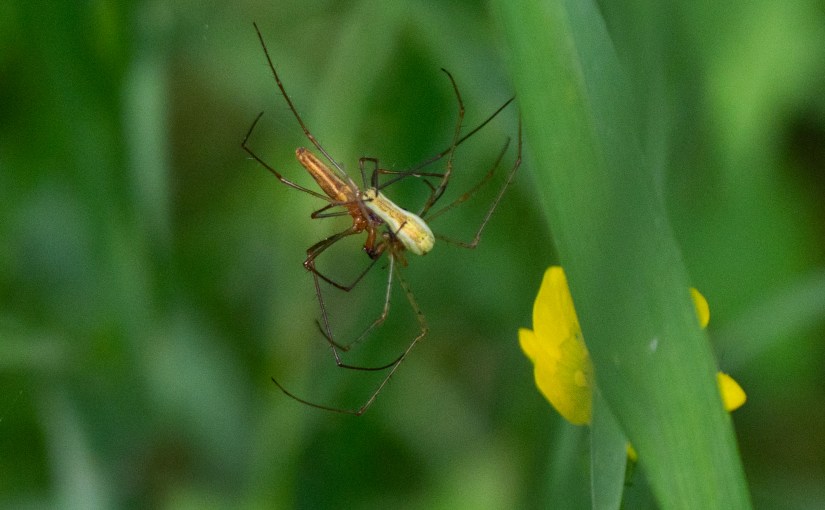
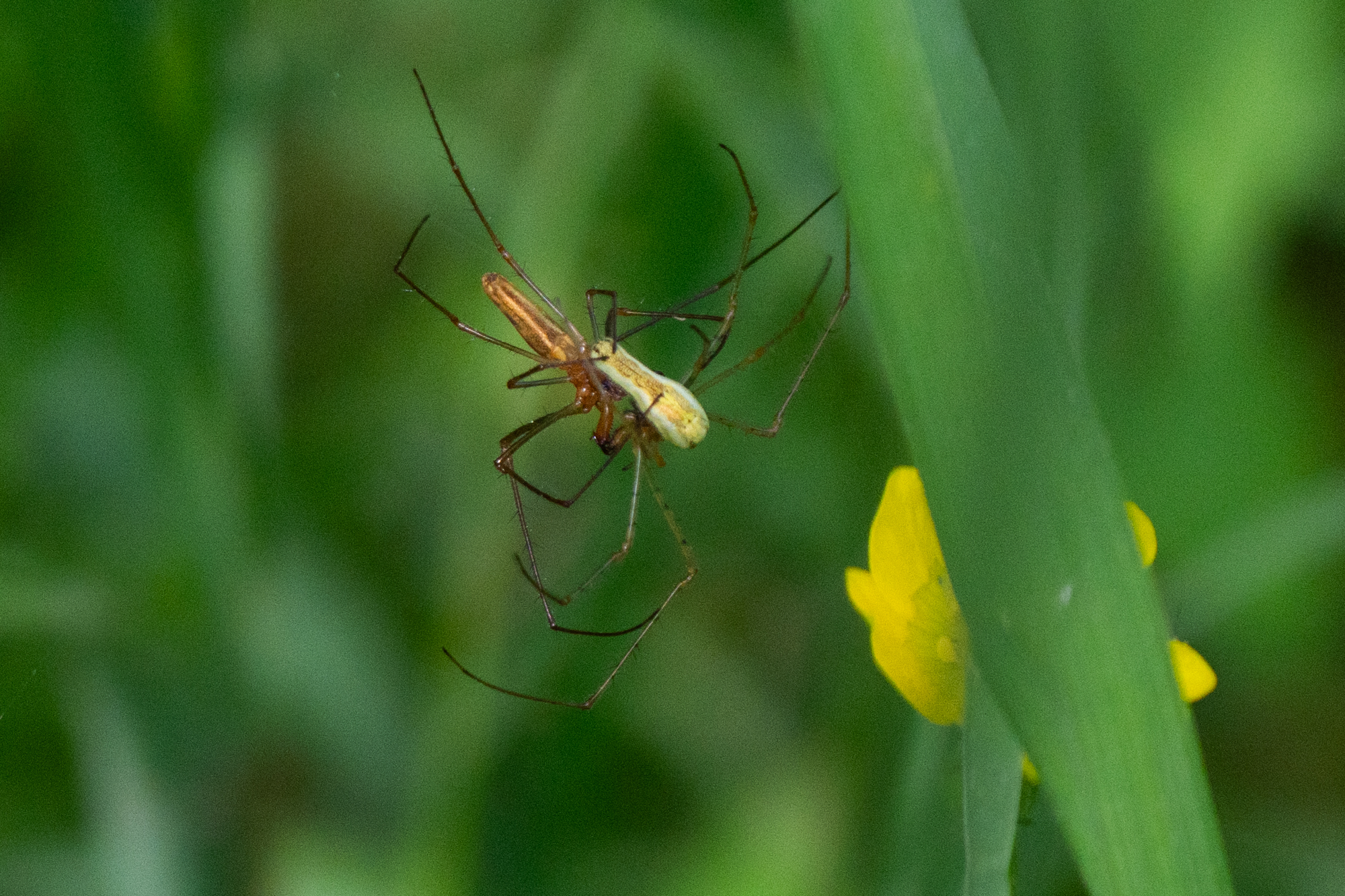
During our walk in Nature reserve the ‘Riethoek’ (Reedcorner, Amsterdam Zuidoost), looking for small creepy crawlies for our ‘1000 species year’ project, we were just focusing on a Long Jawed Spider when this happened:
Long Jawed spider male in stretch poseTaps a stretched web threadStrekspin vrouw verschijnt – bevruchtingFemale spider appears – fertilizationThreads come out of the abdomenA net is being madeYellow eggs are addedEgg package almost readyMating Long Jawed spiders Family Tetragnathidae – species still unknown. 2025-05-31 Riethoek, Amsterdam Zuidoost
Today I went for the second time this week to Bussum. I already went a first time on last Sunday morning early, in the hope to catch the first light of sunrise. Sadly, there wasn’t any visible sunrise then – instead, it rained from the moment I left home, and never stopped raining till I came back four hours later, soaking wet! I hiked for about three hours, exploring the Westerheide, a part of the Goois Nature Reserve where I had never been before. But I didn’t even take my rented camera out of my bag, since I didn’t want to take the risk to damage it.
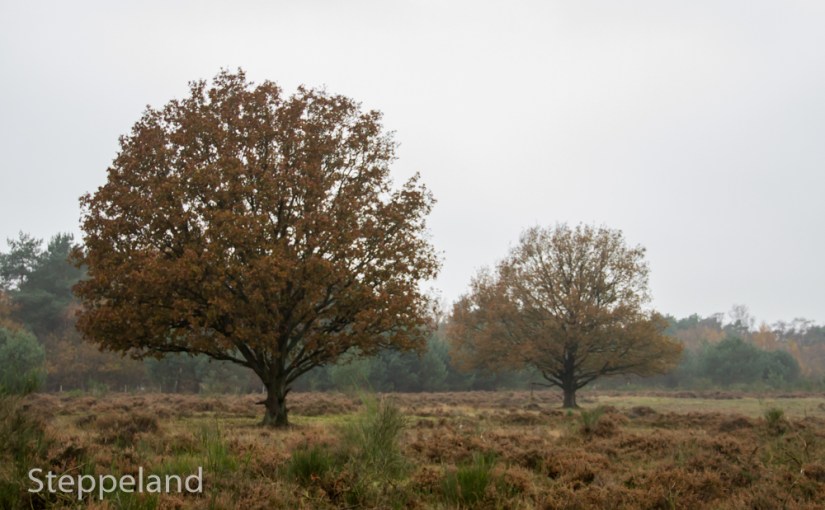
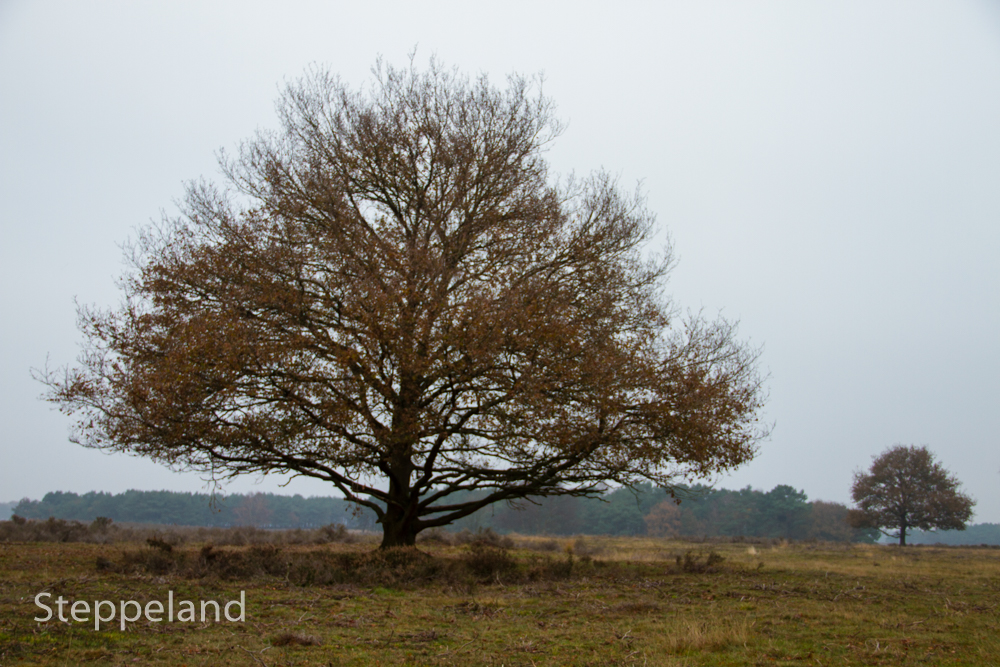
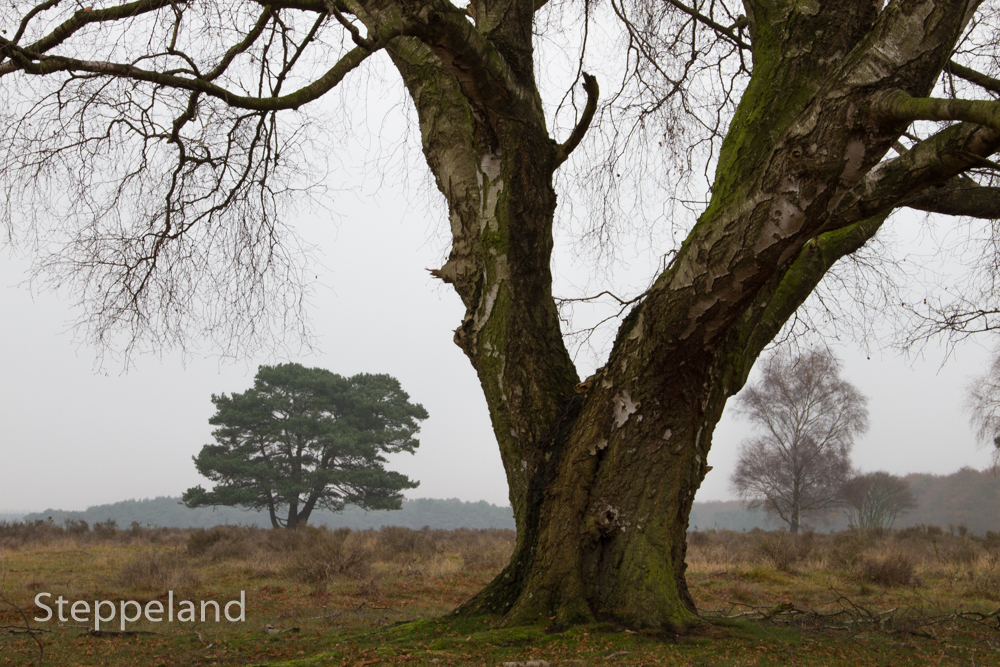
So this morning, I wanted to try my luck again. I know the Goois Nature reserve is at it’s best during Autumn season – especially since the area has a great variety of fungi. And I wanted to photograph at dawn the part of the heath were I saw those marvellous trees day before yesterday… But again, it was very clouded today, so no sign of a sunrise whatsoever. But at least it didn’t rain. So I did manage to make some great pics of the trees I had seen during my scouting of last Sunday. However, half way through the morning, I must have messed up something with the settings of the camera – I don’t know exactly what I did, but at a certain moment the shutter got a delay of about 12” , and I couldn’t find how to set it back to normal. That’s what can happen when you try out a new camera LOL. So well, that was it, time to go back home anyway… I hope the mushrooms will still be there next time I go… with my own camera then! And the trees, hope you enjoy them as much as I did! 😀
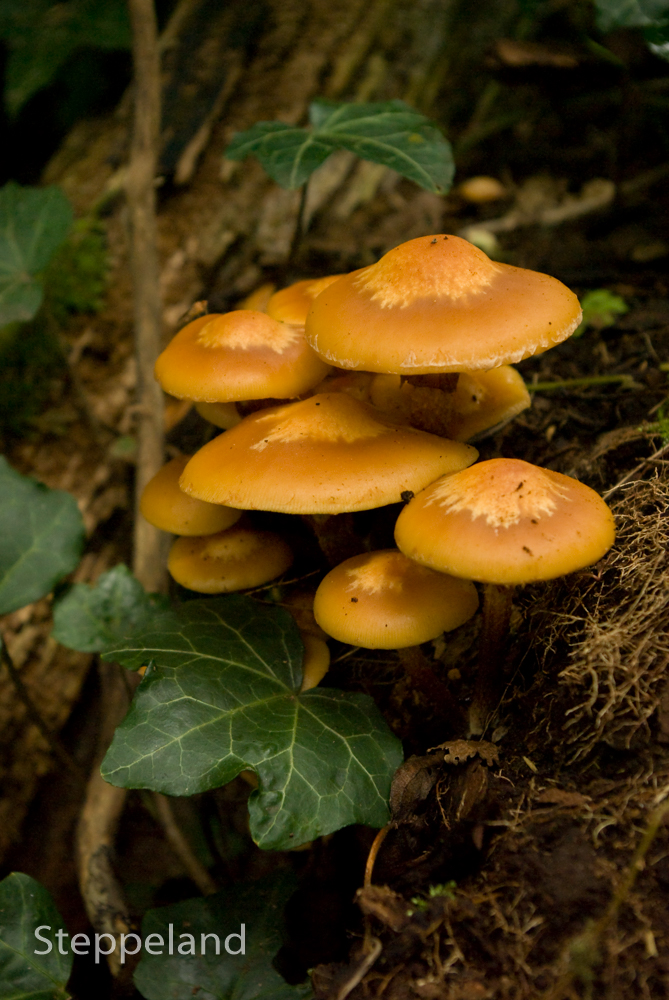
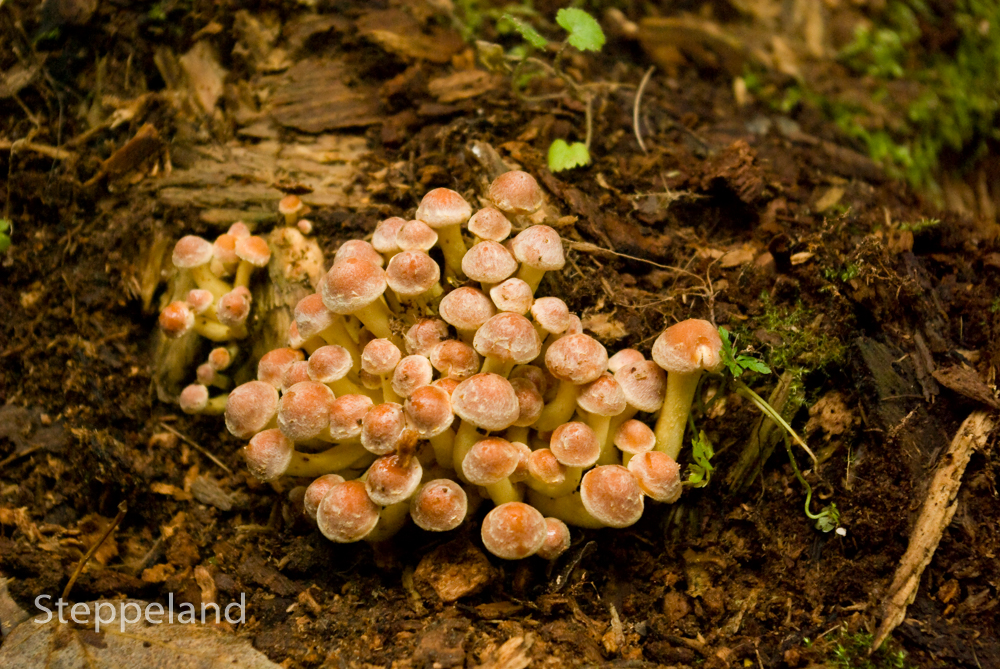
Fall is really the ideal time to make pics of mushrooms in all colours and shapes. This year, I haven’t had much occasion yet to go out into the woods, but last year I did. So, in the hope of having an occasion soon to go for a hike with my camera to make some new fall images, here are a few of the mushrooms I made in Nature reserve the Osbroek in Aalst, Belgium – October 4, 2013
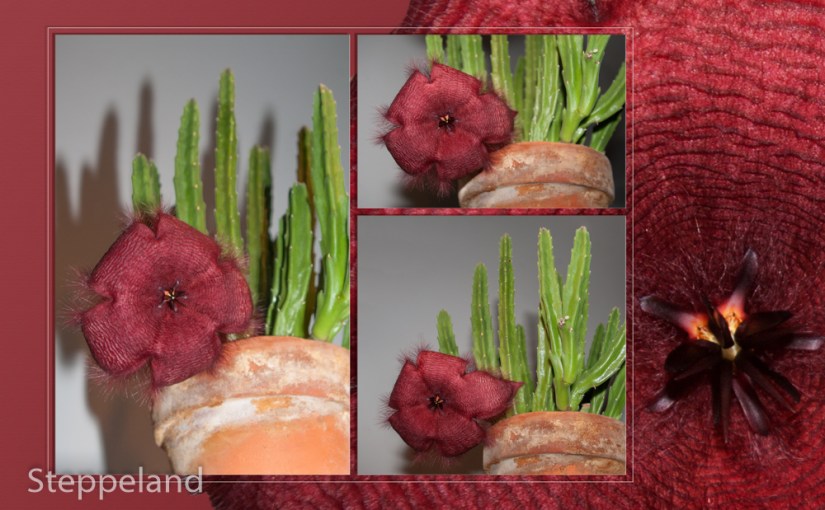
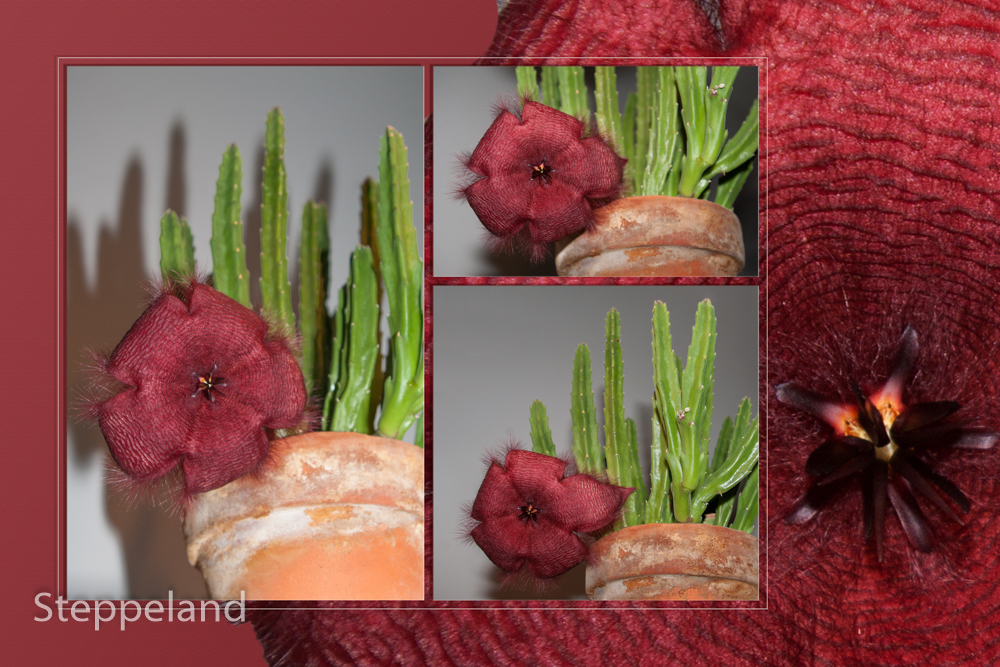
I was visiting a friend this week, and she showed me the amazing flower she got on a little succulent plant on her window sill. What a stunning flower in a deep red colour, and all covered with soft little hairs… I never saw something like this! I happened to have my camera with me, so asked her whether I could make some pictures. Of course that was fine with her. We had to improvise a bit with the placement and lighting, since there was little light inside. And I would have wished that the plant was in a nicer pot… But I was quite happy with the result anyway.
Today I decided to make some of the images into a collage and card-design… Maybe I’ll do some more photoshopping on it later on. Hope you like it 😉
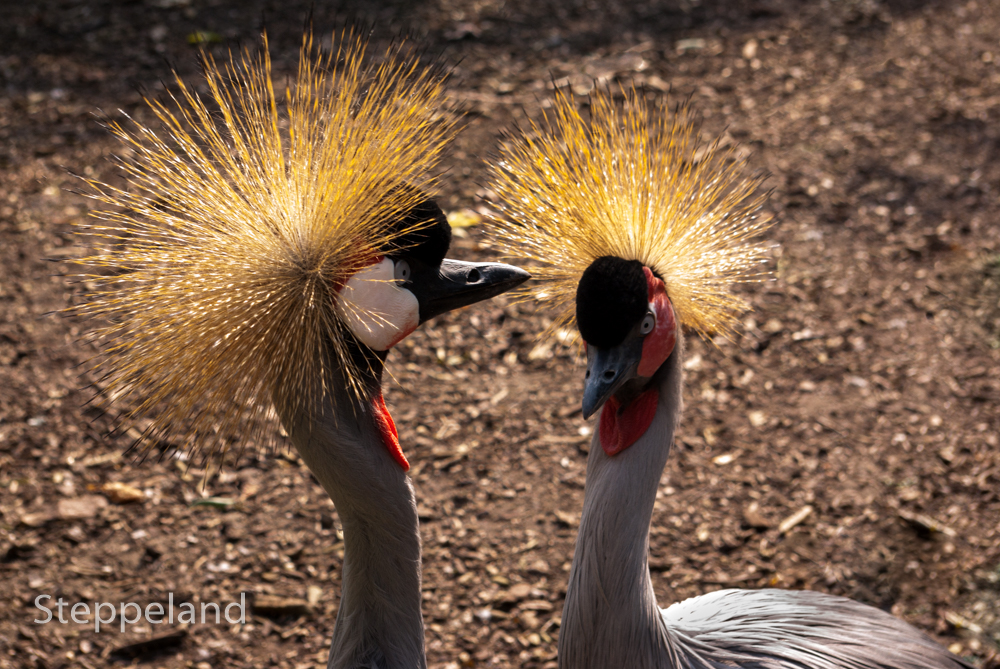
Photo made in ‘de Oliemeulen’ zoo in Tilburg, the Netherlands – Sept. 22, 2014
“Grey crowned cranes (Balearica regulorum) are native to the dry savannah in Africa south of the Sahara, although it nests in somewhat wetter habitats. They can also be found in marshes, cultivated lands and grassy flatlands near rivers and lakes in eastern from the Uganda and Kenya, south to South Africa. This animal does not migrate.
The grey crowned crane has a breeding display involving dancing, bowing, and jumping. It has a booming call which involves inflation of the red gular sac. It also makes a honking sound quite different from the trumpeting of other crane species.
These cranes are omnivores, eating plants, seeds, grain, insects, frogs, worms, snakes, small fish and the eggs of aquatic animals. Stamping their feet as they walk, they flush out insects which are quickly caught and eaten. The birds also associate with grazing herbivores, benefiting from the ability to grab prey items disturbed by antelopes and gazelles. They spend their entire day looking for food. At night, the crowned crane spends it time in the trees sleeping and resting.
The grey crowned crane is the national bird of Uganda and features in the country’s flag and coat of arms.
Although the grey crowned crane remains common over much of its range, it faces threats to its habitat due to drainage, overgrazing, and pesticide pollution. In 2012 it was uplisted from vulnerable to endangered by the IUCN.” Source: Wikipedia









 Discovering Beauty