Orangutan – Read my thoughts


Deze blog post in het Nederlands (link)
 

Orangutan - Read my thoughts
Orangutan – Read my thoughts

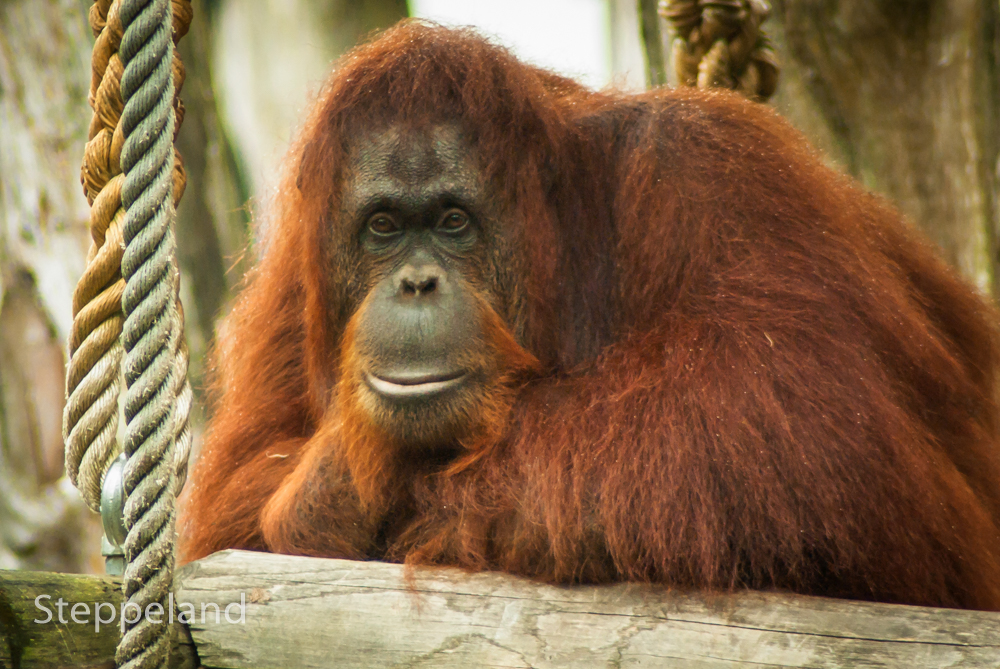
Orangutan with pensive eyes – could we only read it’s thoughts… Photographed in Apenheul zoo, Apeldoorn, the Netherlands


Orangutan

Quote:

“The orangutans are the two exclusively Asian species of extant great apes. Native to Indonesia and Malaysia, orangutans are currently found in only the rainforests of Borneo and Sumatra.
The name “orangutan” (also written  is derived from the Malay and Indonesian words orang meaning “person” and hutan meaning “forest”, thus “person of the forest”.
Orangutans are the most arboreal of the great apes and spend most of their time in trees. Their hair is typically reddish-brown, instead of the brown or black hair typical of chimpanzees and gorillas. Males and females differ in size and appearance. Dominant adult males have distinctive cheek pads and produce long calls that attract females and intimidate rivals. Younger males do not have these characteristics and resemble adult females. Orangutans are the most solitary of the great apes, with social bonds occurring primarily between mothers and their dependent offspring, who stay together for the first two years. Fruit is the most important component of an orangutan’s diet; however, the apes will also eat vegetation, bark, honey, insects and even bird eggs. They can live over 30 years in both the wild and captivity.

Conservation status
During the early 2000s, orangutan habitat has decreased rapidly due to logging and forest fires, as well as fragmentation by roads. A major factor in that period of time has been the conversion of vast areas of tropical forest to palm oil plantations in response to international demand. Palm oil is used for cooking, cosmetics, mechanics, and biodiesel. Hunting is also a major problem as is the illegal pet trade. Orangutans may be killed for the bushmeat trade, crop protection, or for use for traditional medicine. Mother orangutans are killed so their infants can be sold as pets, and many of these infants die without the help of their mother.
As a result of all this, both species are on the IUCN Red List of Mammals. The Sumatran species is critically endangered and the Bornean species is endangered.” Source: Wikipedia
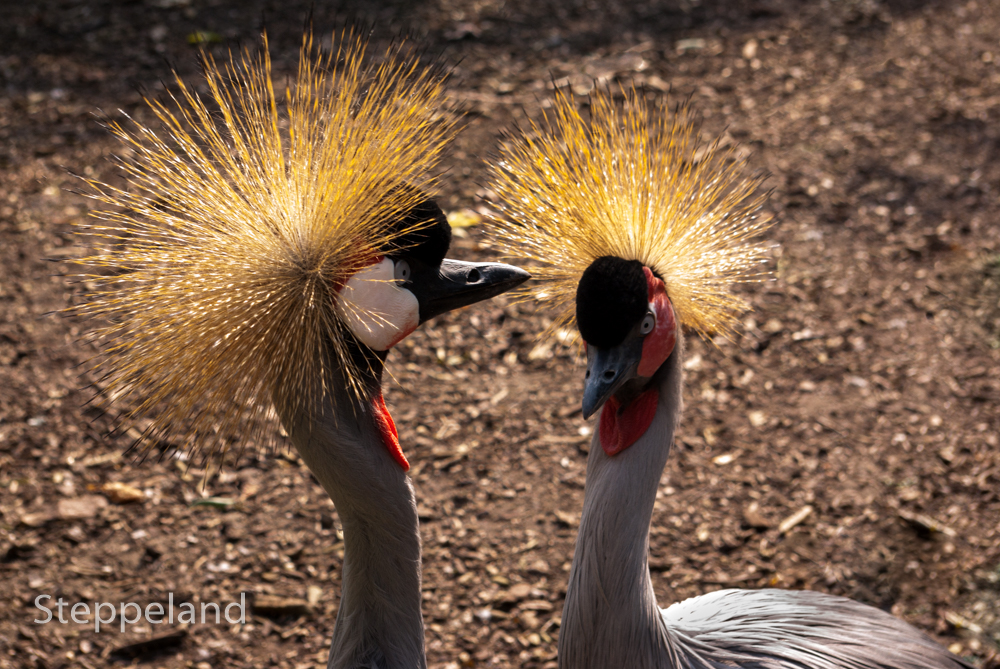
 

Two Grey crowned cranes with golden crown


Deze blog post in het Nederlands (link)

Two grey crowned cranes with golden crown

Photo made in ‘de Oliemeulen’ zoo in Tilburg, the Netherlands – Sept. 22, 2014

Grey crowned cranes (Balearica regulorum) are native to the dry savannah in Africa south of the Sahara, although it nests in somewhat wetter habitats. They can also be found in marshes, cultivated lands and grassy flatlands near rivers and lakes in eastern from the Uganda and Kenya, south to South Africa. This animal does not migrate.

The grey crowned crane has a breeding display involving dancing, bowing, and jumping. It has a booming call which involves inflation of the red gular sac. It also makes a honking sound quite different from the trumpeting of other crane species.

These cranes are omnivores, eating plants, seeds, grain, insects, frogs, worms, snakes, small fish and the eggs of aquatic animals. Stamping their feet as they walk, they flush out insects which are quickly caught and eaten. The birds also associate with grazing herbivores, benefiting from the ability to grab prey items disturbed by antelopes and gazelles. They spend their entire day looking for food. At night, the crowned crane spends it time in the trees sleeping and resting.

The grey crowned crane is the national bird of Uganda and features in the country’s flag and coat of arms.

Although the grey crowned crane remains common over much of its range, it faces threats to its habitat due to drainage, overgrazing, and pesticide pollution. In 2012 it was uplisted from vulnerable to endangered by the IUCN.” Source: Wikipedia

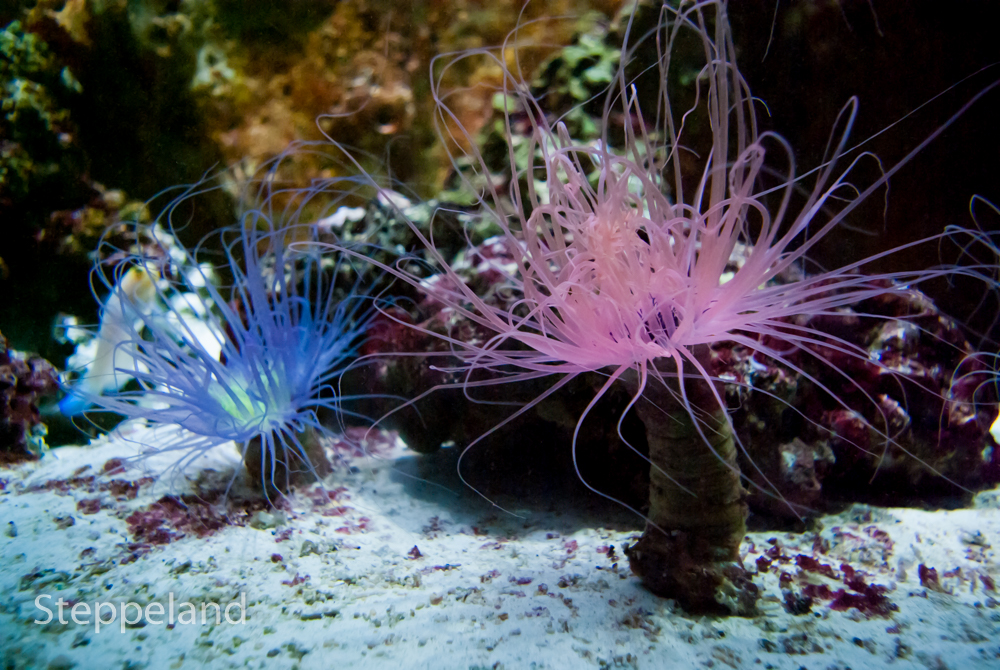
Tube dwelling anemones, wonderful creatures of the sea


Deze blogpost in het Nederlands (link)

Today, I would like to show you one of my recent nature photographs. Let’s make Wednesday the #WonderfulNature day 😉

Sea Anemones, wonderful creatures of the sea

Photo of two tube dwelling anemones, a blue and a pink one, photographed in the Aquarium of Artis Amsterdam zoo, the Netherlands (August 31, 2014)

Tube-dwelling anemones or cerianthids look very similar to sea anemones, but belong to an entirely different subclass of anthozoans. They are solitary, living buried in soft sediments. Tube anemones live and can withdraw into tubes, which are made of a fibrous material, which is made from secreted mucus and threads of nematocyst-like organelles, known as ptychocysts.

Cerianthids have a crown of tentacles that consists of two whorls of distinctly different sized tentacles. The outer whorl consists of large tentacles that extend outwards. These tentacles taper to points and are mostly used in food capture and defence. The smaller inner tentacles are held more erect than the larger lateral tentacles and are used for food manipulation and ingestion.” Source: Wikipedia

Red Parrot, the Scarlet Macaw – portrait


Bekijk mijn parallel blog in het NEDERLANDS


Scarlet Macaw
Scarlet Macaw

Another beautiful bird, photographed in Pairi Daiza, a marvellous themed zoo in Brugelette, Belgium
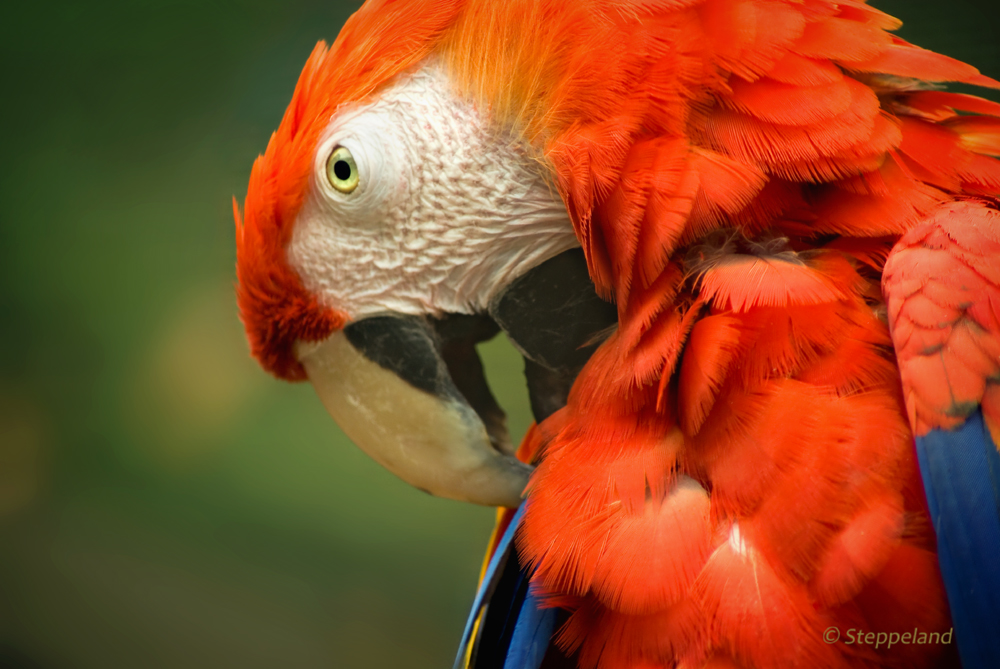
This red, blue and yellow parrot, the Scarlet Macaw (Ara macao), is native to humid evergreen forests of tropical South America. It has suffered from local extinction through habitat destruction and capture for the parrot trade, but locally it remains fairly common. This colourful parrot is on the IUCN list of threatened species, status: Least concern (source: Wikipedia)

Coot on it’s nest


Coot on it's nest 1

Coot on it's nest 2

It had been a long time that I didn’t visit the ReedCorner (de Riethoek) , a small nature area surrounded by the highly populated neighbourhoods of Amsterdam SouthEast (The Netherlands) – But on Easter Sunday, although the sun was hiding behind the clouds again, I thought it was time to have a walk… and I definitely wasn’t disappointed.

I enjoyed seeing and photographing several water birds, of which some were already nesting – and lots of little flowering herbs… the first messengers that spring truly is on its way! 🙂

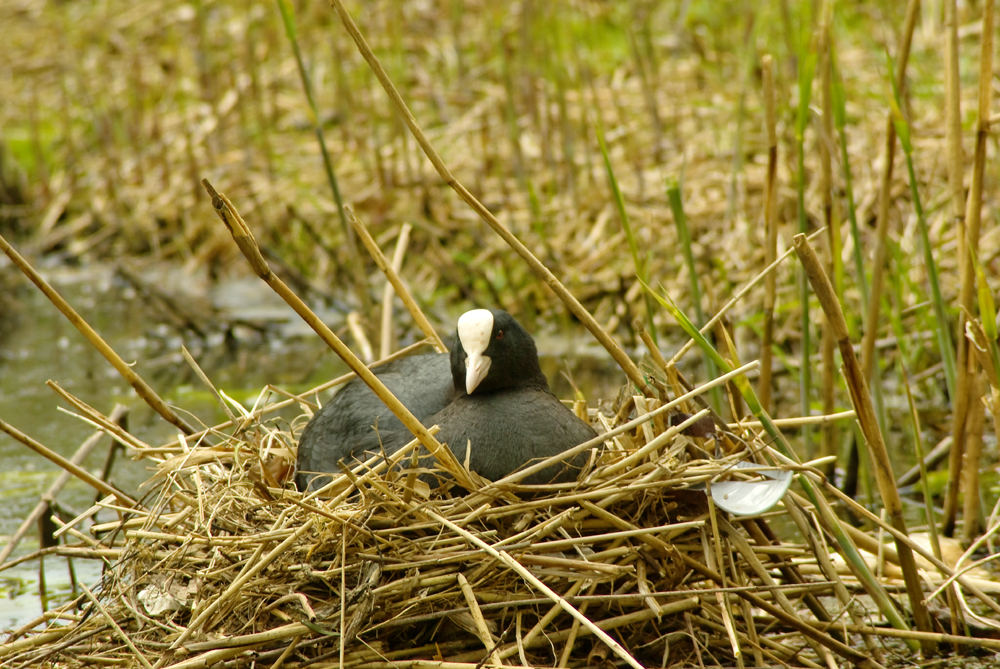
This Eurasian Coot clearly is already breeding… soon we’ll be able to see her ugly but eccentric young scavenging the sides of our ditches and ponds, and mom will have her hands full keeping an eye on them… For now, she still can enjoy the quiet for a little while… 🙂

Did you already see any nesting birds in your neighbourhood?

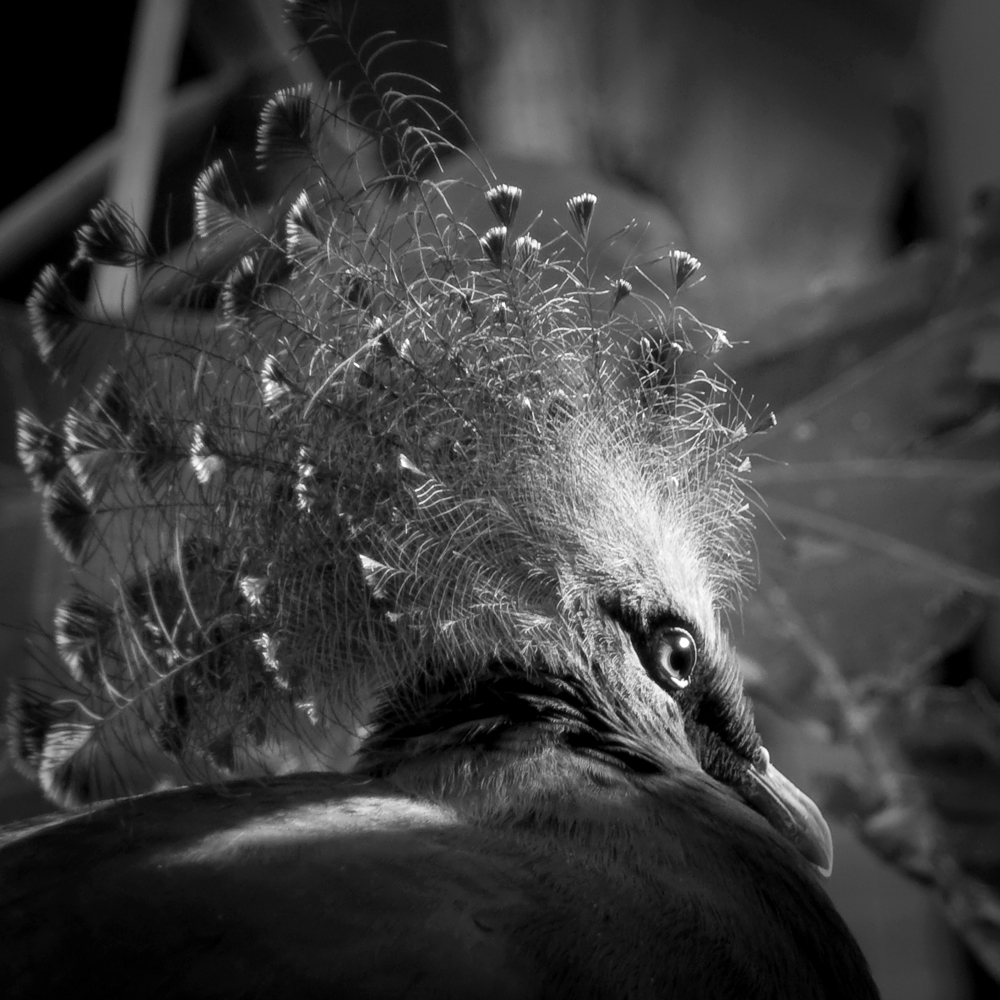
Victoria Crowned Pigeon


Victoria Crowned Pigeon
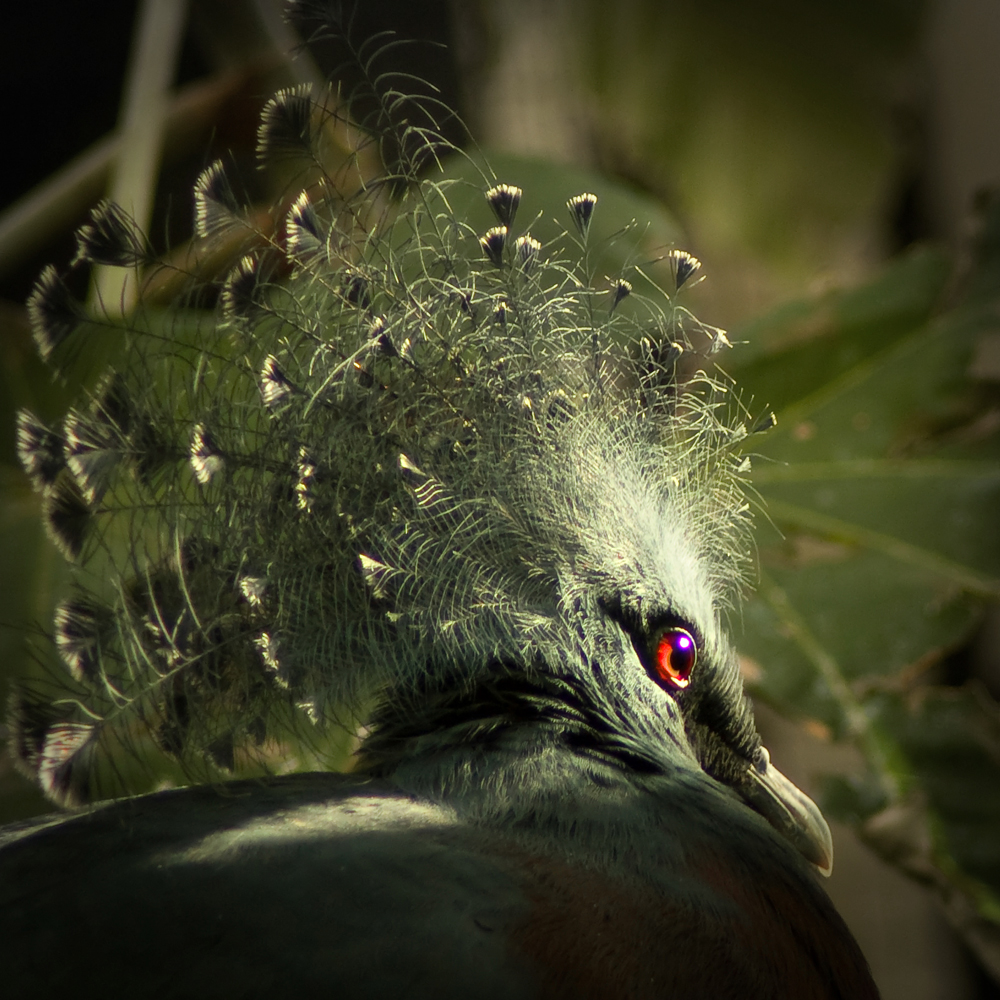
photographed in Artis, Amsterdam Zoo - Feb. 11, 2012

“The Victoria Crowned Pigeon, Goura victoria, is a large, bluish-grey pigeon with elegant blue lace-like crests, maroon breast and red iris. The bird may be easily recognized by the unique white tips on its crests.

It is distributed in the lowland and swamp forests of northern New Guinea and surrounding islands. Its diet consists mainly of fruits, figs, seeds and invertebrates. The female usually lays a single white egg.

Due to continuing habitat loss, being tame and easily hunted for its plumes and meat, the Victoria Crowned Pigeon is evaluated as Vulnerable on the IUCN Red List of Threatened Species. ” (Source: Wikipedia)

Vict. Crowned Pigeon - detail It’s a beautiful bird indeed –

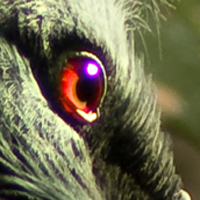
Due to the light reflection, the normally red eye turned partially purple here… amazing…


And this is the black-and-white version…

Victoria Crowned Pigeon - BW

Big Eyes…


Burrowing Owl (Athene cunicularia) photographed in Artis Amsterdam Zoo today – Such a warm and soft plumage, and such big eyes…  – cute little thing 🙂

Of course I made a lot more photo’s but this was one of the first ones I edited, so, liked to share it here already..

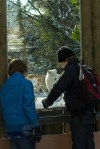
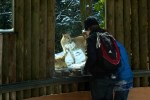
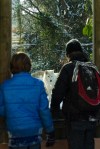
Two boys and the wolves


It’s already a few weeks on Saturdays that I’ve been following a photography course in Artis Amsterdam zoo. Last Saturday, it was the 3d out of 4 meetings, and our assignment of the day was to make a photo-story with a series of images. We had the first snow just a day before, so it was a special occasion to make photo’s on a snowy but sunny day in Artis. I had hoped that maybe I could go make some pics at the Arctic wolves’ enclosure that day, because I knew that a new group of wolves had arrived at the zoo some time last year, and some months a go, the news had been spread that three young wolves were born. So since I hadn’t been able to go see them yet, this assignment would make for a great opportunity to go see what was happening at the wolves’ .

I must say, I really was lucky with the photo-opportunities, and enjoyed my afternoon with the wolves, and those two boys, they did too 😉 …

“Two boys and the wolves…”

– Artis Amsterdam Zoo – a photo-story … :